

Blog
Understanding the Legend: Vintage Neumann U 87 (U 87 i) vs. Modern U 87 Ai

A Complete Guide to Differences, Circuit Changes, and Studio Performance
Understanding the Legend: Vintage Neumann U 87 (U 87 i) vs. Modern U 87 Ai
The Neumann U 87 is arguably the most recognized and widely used large-diaphragm condenser studio microphone in recording history. Found in world-class recording facilities globally, it has defined the sonic footprint of countless hit records, voiceovers, and broadcasts.
However, audio engineers, collectors, and producers frequently debate the differences between the original vintage U 87 (U 87 i) and the currently produced U 87 Ai. In this guide, we break down their naming history, visual differences, internal circuit architecture, acoustic characteristics, and distinct advantages for different studio applications.
1. Decoding the Names: What Does “i” and “Ai” Mean?
To understand the evolution of the U 87 family, it helps to understand Neumann’s designation suffixes:
- U 87 / U 87 i (1967 – 1986): The suffix “i” stands for International. It signifies that the microphone is equipped with a standard 3-pin XLR connector. Early German domestic variants used Tuchel (small round) connectors. Therefore, “U 87” and “U 87 i” refer to the exact same first-generation vintage microphone.
- U 87 Ai (1986 – Present): The “A” stands for Advanced. It denotes the major second-generation redesign introduced in 1986, featuring upgraded DC-DC converter circuitry, higher capsule polarization, higher output sensitivity, and reduced self-noise.
2. Exterior & Physical Comparison
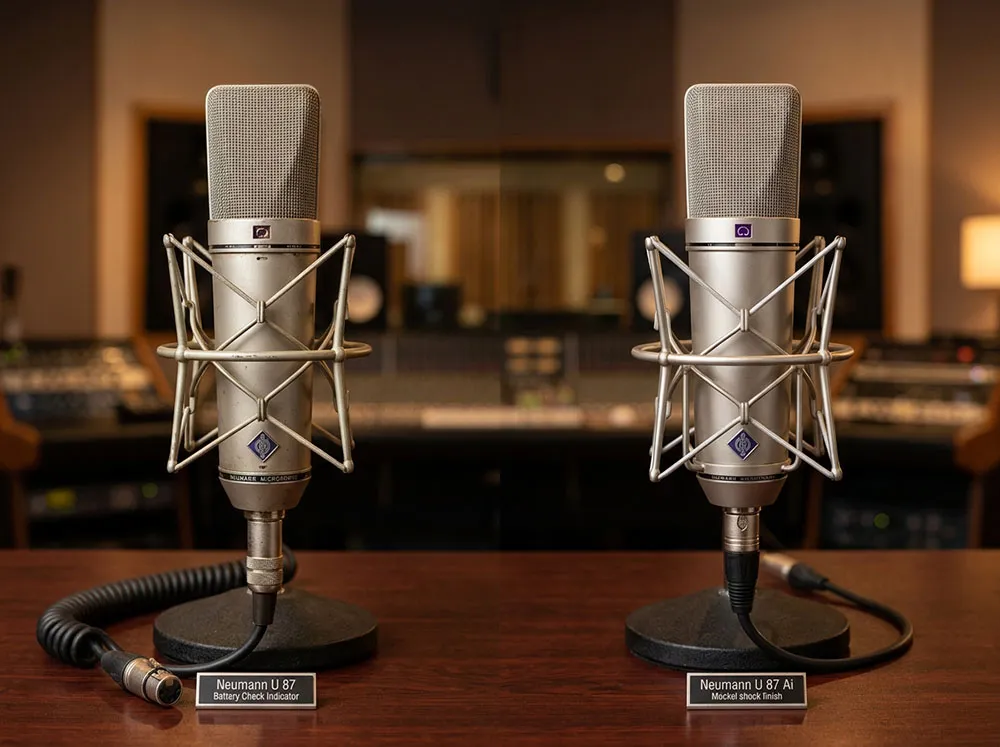
While both microphones share Neumann’s classic conical body shell and chrome headgrille, subtle physical markers make them easy to tell apart:
- Battery Indicator Window (Vintage U 87 i Only): Because phantom power was not ubiquitous in the late 1960s, the original U 87 included an internal battery compartment for two 22.5V batteries. The outer body tube features a small meter switch/window to test battery charge.
- Smooth Body Tube (Modern U 87 Ai): The U 87 Ai removed the internal battery chamber, resulting in a continuous, smooth metal body tube with no battery window.
- Engraved Base Plate Badge: The metal collar surrounding the XLR connector clearly specifies the model: engraved as
U 87 ion vintage models orU 87 Aion current production units.
3. Internal Architecture & Capsule Engineering
Under the hood, the two generations rely on different electronic philosophies:
- Capsule Design (K 87 vs. K 67 / K 870):
- U 87 / U 87 i: Uses the K 87 capsule. Because the microphone had to run on battery power, the capsule’s backplate halves were insulated from each other to prevent shorting.
- U 87 Ai: Uses the K 67 / K 870 capsule (the same design used in the legendary U 67 tube microphone). With battery operation eliminated, both backplates are connected directly and polarized independently.
- Polarization Voltage & Output Circuitry:
- U 87 / U 87 i: Operates at a lower polarization voltage (approx. 40V to 60V single-ended), yielding a lower output signal level.
- U 87 Ai: Features an active internal DC-DC converter that steps up 48V phantom power to supply full 60V dual polarization. This increases output sensitivity by approximately +10 dB and reduces self-noise from 18 dB-A to a quiet 12 dB-A.
4. Technical Specifications at a Glance
| Feature / Specification | Vintage U 87 / U 87 i (1967–1986) | Modern U 87 Ai (1986–Present) |
|---|---|---|
| Power Supply | 48V Phantom Power OR Internal Batteries | 48V Phantom Power Only |
| Body Feature | Battery check window on casing | Smooth casing (no window) |
| Capsule Model | K 87 | K 67 / K 870 |
| Sensitivity (Cardioid) | ~8 mV/Pa (Lower Output) | ~28 mV/Pa (+10 dB Higher Output) |
| Self-Noise Level | ~18 dB-A | ~12 dB-A (Lower noise floor) |
| Polar Patterns | Cardioid, Omnidirectional, Figure-8 | Cardioid, Omnidirectional, Figure-8 |
| Pad & Low-Cut | -10 dB Pad / High-pass filter | -10 dB Pad / High-pass filter |
5. Acoustic Profiles, Advantages & Best Use Cases
🎙️ Vintage U 87 (U 87 i) — The Warm Classic
Sound Character: Smooth mid-range response, slightly rolled-off top end, and a warm, organic character with vintage analog saturation.
Key Advantages: Softens harsh sibilance naturally; highly tolerant of aggressive preamps; delivers legendary musical warmth.
Ideal Use Cases: Vintage-style vocal tracking, bright acoustic guitars, brass instruments, electric guitar cabinets, and warm jazz/blues vocals.
🎙️ Modern U 87 Ai — The Crisp Precision Standard
Sound Character: High output signal, exceptionally low noise floor, enhanced presence in the upper frequencies, and forward “in-your-face” voice articulation.
Key Advantages: +10 dB higher sensitivity requires less preamp gain; captures delicate transient details with ultra-low background noise.
Ideal Use Cases: Modern pop/rap vocal production, voiceover, audiobook narration, broadcast studios, orchestral overheads, and subtle acoustic fingerpicking.
6. Summary & Buying Guidance
Neither microphone is inherently “better”—they serve different aesthetic needs in modern audio production:
- Choose the U 87 Ai if your workflow requires pristine signal-to-noise ratios, modern vocal presence, and maximum sensitivity for modern pop or voiceover work.
- Choose a vintage U 87 / U 87 i if you prefer a laid-back, smooth high-end response, natural sibilance control, and classic analog warmth.
If you want U87 AI body or Condenser Microphone, pls check in our MaiAo website for it.